


Products
HDI Rigid-Flex Board-26L
With the rapid growth of the HDI Rigid-Flex Board market, the industry is progressively advancing toward high reliability, higher layer counts, and HDI trends. Customers of high-layer HDI Rigid-Flex Boards are also setting increasingly stringent quality standards. However, traditional processing methods often face challenges such as lamination misalignment, uneven copper plating, and significant flexural deformation after lamination. These issues result in poor quality, including defects like dry film peeling in circuit areas, which fail to meet the required quality standards. Therefore, addressing these challenges is essential to meet the growing demands for high-performance HDI Rigid-Flex Boards.
Product of HDI Rigid-Flex Board-26L technoical's date
| BSI's PCB Features | BSI's technical spec |
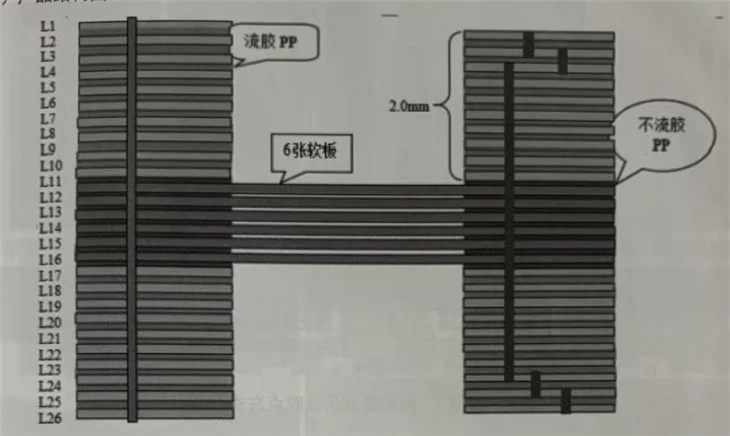
| Number of layers | 26 layers(10R+6F+10R) |
| Board thickness | 4.0 |
| FPC thickness | 0.1 |
| Minimi hole | 0.3mm |
| Ratio | 12:1 |
| Hole to line | 0.19mm |
| Blind design | Second order |
| Surface finishes available | ENIG |
| Lamination | 3 times |
HDI Rigid-Flex Board's procedure

| Introduction to Key Technical Challenges for HDI Rigid-Flex Board-26L : |
| (1) Optimization design of engineering documents; |
| (2) Process optimization; |
| (3) OPE punching for flexible boards; |
| (4) Control method for laminate layer offset during lamination; |
| (5) Control method for multiple lamination shrinkage and expansion matching; |
| (6) Plating copper uniformity control. |
the production of this 26-layer HDI Rigid-Flex Board is summarized as follows:
1.Glue Flow Channel Design: Designing glue flow channels on the process edges proves to be more effective than glue flow points in improving surface wrinkles and depressions on the laminated board. This is particularly critical in ensuring the surface flatness of an HDI Rigid-Flex Board.
2.Lamination Pre-compensation: Pre-compensation during lamination, aligned with the first lamination process, helps to effectively address shrinkage and expansion issues. This method is essential to meet the strict dimensional stability requirements.
3.Precise Alignment with Punching and Pinning: After performing OPE punching on both flexible and rigid boards, using pins and rivets for alignment effectively resolves the issue of lamination layer misalignment, ensuring the integrity of the multi-layer structure in an HDI Rigid-Flex Board.
4.Vertical Pulse Plating for Uniform Copper Plating: Utilizing vertical pulse electroplating (VCP) effectively improves the uniformity of copper plating, ensuring the reliability of copper thickness in the product. This process is critical for maintaining electrical and mechanical reliability in HDI Rigid-Flex Boards.
In conclusion: The key points for producing high-layer HDI Rigid-Flex Boards include:
The glue flow channel design ensures surface flatness.
Pre-compensation addresses shrinkage and expansion.
After punching flexible boards, precise alignment using pinning and riveted holes, combined with three-in-one pressing and white paper buffering during total lamination, eliminates misalignment during lamination.
The uniformity of plated holes relies on the stability of advanced pulse plating techniques.
These optimizations ensure that HDI Rigid-Flex Boards meet the high reliability and performance standards required for modern applications.
Hot Tags: hdi rigid-flex board-26l, China hdi rigid-flex board-26l manufacturers, suppliers, factory, F4BM265 Combiner Circuit Board, Arlon PCB, Street lamp PCBA, EMS, Halogen Free boards Halogen Free, F4BM radar circuit board Flash gold electroplated gold Gold finger


